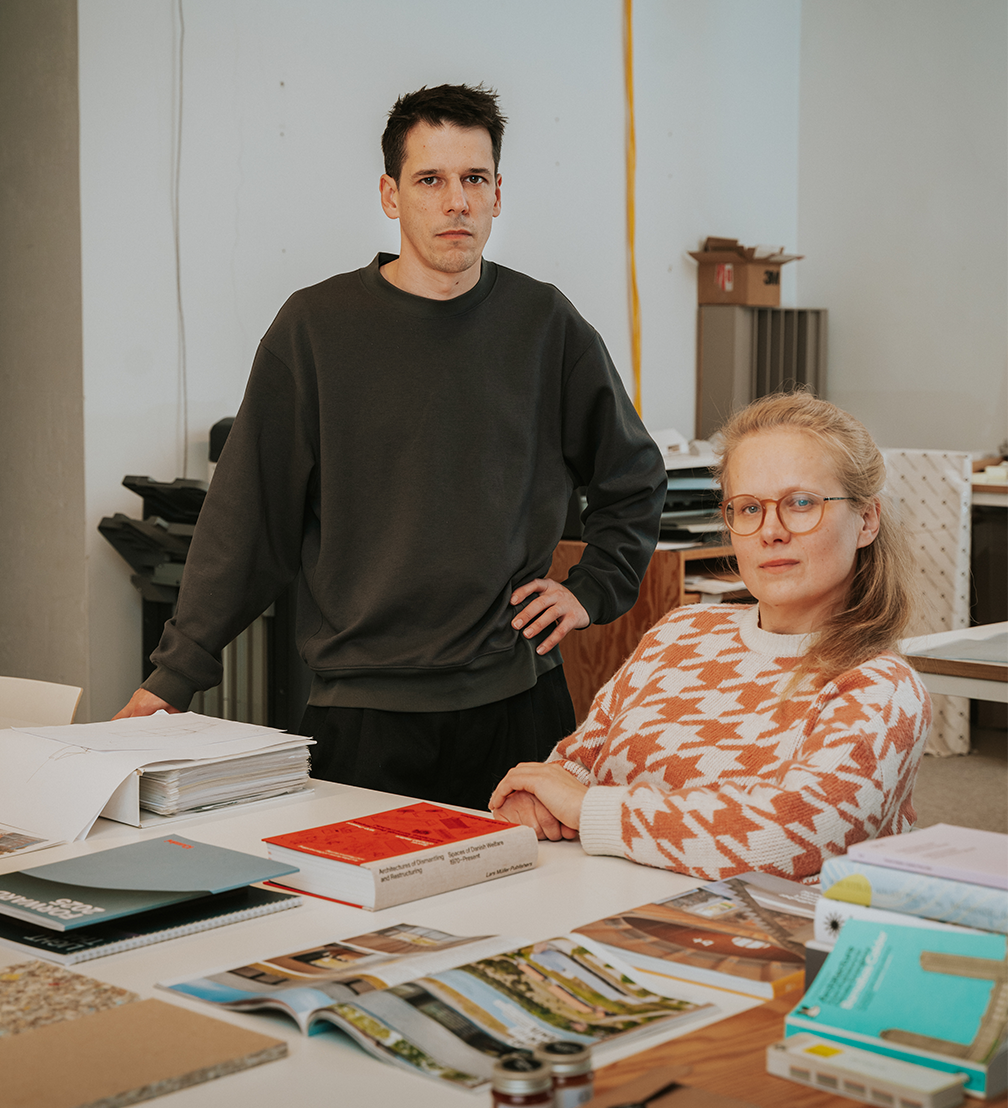
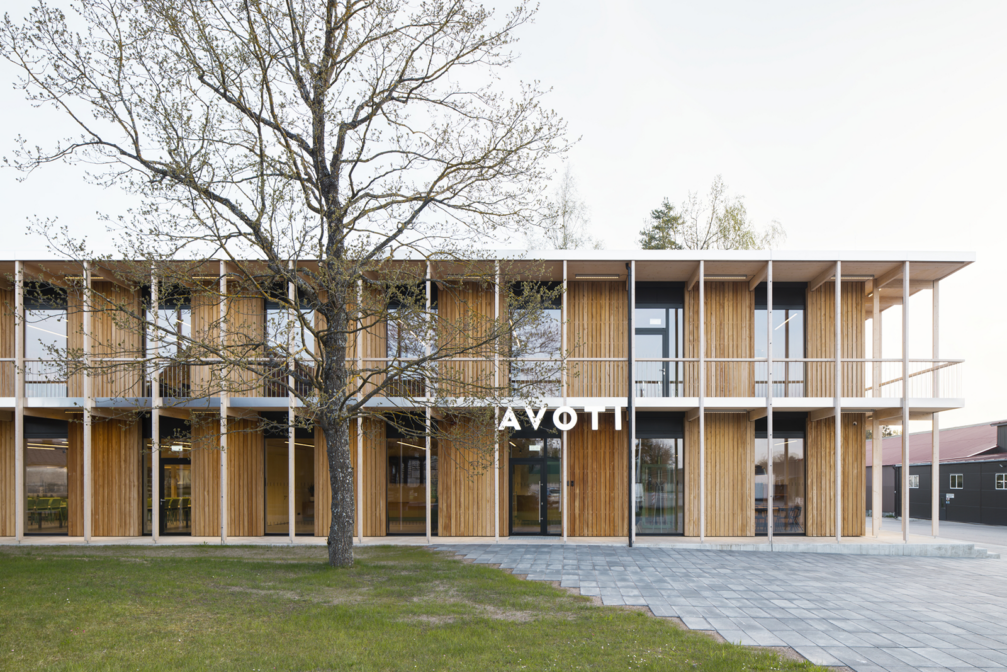
Architecture office MADE Arhitekti has been implementing socially and ecologically responsible design since 2007, paying special attention to healthy and sustainable timber construction. They won the Latvian Architecture Award 2025 Grand Prix for the wooden kindergarten in Salaspils, which is the first public building in the Baltics to receive a passive building certificate. In the interview, the office’s founders, Linda Krūmiņa and Miķelis Putrāms, talk about the merging of practicality and beauty and the gentle power of the architect.
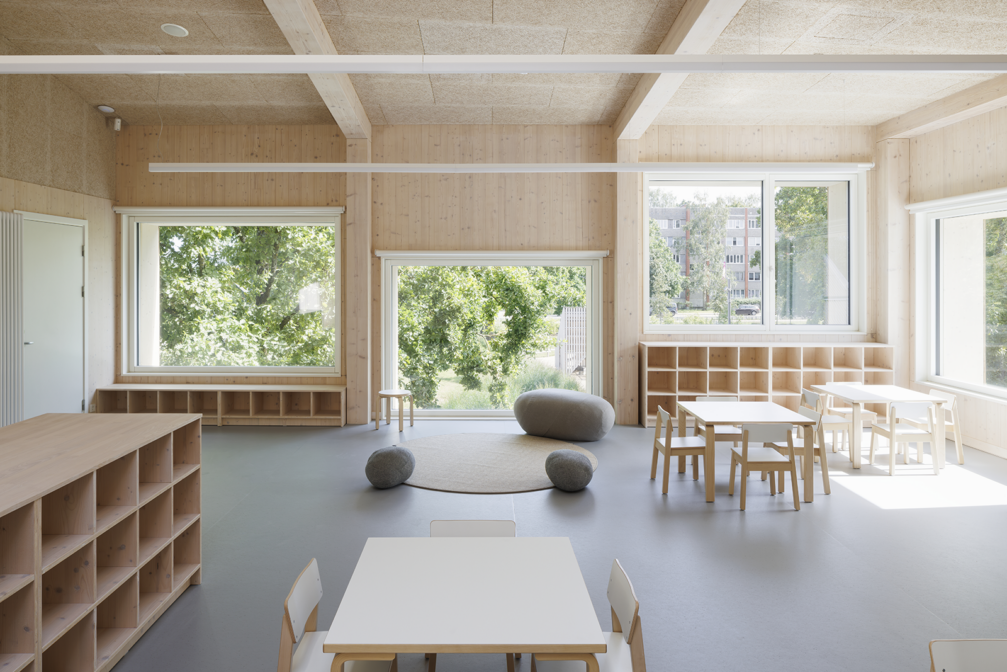
We already have an exhaustive publication about the Salaspils kindergarten in FOLD, but I want to ask you — what gave you both the greatest satisfaction about this project?
Miķelis Putrāms:
We have gained confidence that we understand what we are doing. The Salaspils kindergarten is not just a house, it takes into account chemistry, materials, construction technologies, engineering systems, ecology, natural climatic conditions — it is a complex mechanism that proves that our holistic strategy works adequately in reality, and we are allowed to insist on our opinions. This gives confidence in our ideas and principles.
Linda Krūmiņa:
My greatest satisfaction is that it is a municipal kindergarten — anyone who lives in Salaspils and has waited in the queue can get in. It is a high-quality product available to the entire community. Maybe it would be easier to do with an educated private client, maybe there would be fewer restrictions and procurements, but we managed to implement it with all the bureaucratic loops as a municipal project.

This is not the first time that you have achieved excellent results while working with the state or a municipality as a client. Are you lucky with clients, or is the perception that a public client is difficult just a bias?
Linda:
Salaspils municipality was a demanding and principled client, but it suited us very well. We like it when the client has high requirements and a strict budget; it is much better than when the client does not care. For us, those qualities that might seem burdensome to others were only beneficial in order to be able to realise the Salaspils kindergarten as it is.
Miķelis:
I have read about a study where teachers are told which school class is the good one and which is the bad one, even though both are completely equal in their performance and behaviour. The conclusion is that whatever the teachers are told, so the pupils end up being. Maybe it is the same with clients. I think that architects should yield to the client; the client should not be questioned or challenged. With a tolerant, favourable and accommodating attitude, you can achieve more than by arguing or trying to prove that architecture is important. Nobody is actually interested in architecture; people are interested in their own well-being, their own interests and dreams, and our task is to solve these human problems.
Linda:
Public projects are special in that we ourselves are also clients. For example, during the Daile Theatre square project, the representatives of the State Real Estate Agency changed, the theatre director changed, Riga’s leadership changed, but we ourselves were also able to represent the interests of the client, because we, as city users, understand what such a square needs.
Miķelis:
Building regulation has this somewhat abstract text: «construction participants represent the interests of the client». An architect is best able to represent these interests, and if the architect represents the interests of the client and sees the connections of how the interests of the client will be affected during the project, then the other construction participants can operate normally. I think an architect has enormous power, unless he starts arguing and thinking more about his own interests, it’s kind of a soft power.

You talk about your projects in a practical, down-to-earth language, putting functionality, the user, the quality of the environment, and other aspects at the forefront. How and when do aesthetic considerations appear in your work?
Linda:
All these considerations work together, but nothing ugly will leave the office. It’s something unformulated and unwritten, something we simply feel. But if we don’t like it and it doesn’t look nice, then the project isn’t ready. Passive houses have always seemed so ugly to us that it’s a kind of challenge to make a beautiful passive house. But a project never starts with aesthetics, we primarily solve social and practical problems, and aesthetics is another sieve through which the project passes.
Miķelis:
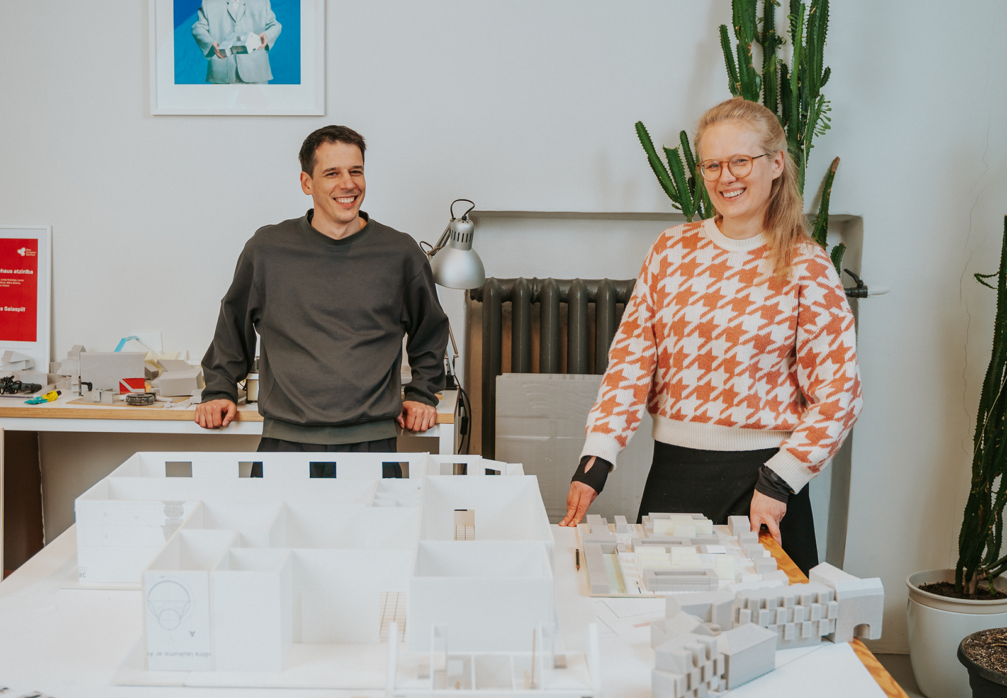
At the same time, aesthetics and proportions are very important, because they create emotions. That’s why we always make models — to check whether the proportions are good, whether the openings are big enough, whether the overall composition works. Of course, there are those terrifying situations when you can’t find the right proportion or opening for months and it seems impossible, but always, like a miracle, a solution comes along that combines all the many influences and necessities — both technical and economic aspects, the client’s personality, and our own self-invented, subjective, and indescribable sense of proportion.
How much do you think about the economic side — both of design and of construction?
Miķelis:
I think that in order to build cheaply, you need to invest in intelligence and architects, in the design research process — it will pay off many times over. Everyone wants to build cheap and beautiful, which is not very realistic, but sometimes we manage to find a beautiful solution that is not cheaper but also does not cost more. For example, we had an adventure at a concrete factory where we went to look at concrete textures, and all those ordinary, cheap surfaces were so ugly, but there was no extra money for something better. At one point we see something good and I precisely recall what the concrete factory manager said: «That’s just the bad side, don’t look at it. That’s when we don’t do anything». But that was exactly what we needed. We do a lot of research on different materials and suppliers, looking for those emotionally effective solutions that are not expensive.
Linda:
Of course, if we don’t go to the factory, no one else will find it or come up with it for us. We discuss a lot internally whether our solutions will increase the cost or complicate the project. The cost of the material is one thing, but the simplicity of the construction must also be taken into account.
Miķelis:
For example, it’s often said that public timber buildings will cost more. And in a surface-level analysis, timber for 700 euros per cubic metre is more expensive than concrete. However, in the Salaspils kindergarten, we managed to prove that building from CLT is not much more expensive than from reinforced concrete. When we analysed the total costs of general contractors, it turns out that they don’t care whether to build from timber or concrete. They have other positions that are more important to them — speed, quality, distribution of responsibility across different types of construction, risk issues. It seems to me that builders look at construction very innovatively, but a large part of customers and project managers have outdated views. The very basis of a builders’ thinking is how to build while saving money, so we have to cooperate with them. And if architects distance themselves from cost issues, they lose some of their soft power.
Linda:
Sooner or later, we will have to confront economic issues anyway. It is better to face them before optimisation, when there is more room for manoeuvring to control aesthetics, than when there is not enough money for something. We must act responsibly in advance. We do not draw dream castles and we do not have such a desire either. Rather, we rather try to solve the problems of our customers. Expensive extras in our projects come from the customers, we do not offer luxury solutions ourselves.
Miķelis:
The budget allocated for a project will be spent in any case — whether it’s a well-thought-out and very well-planned building or something illogical and ugly. If the costs are the same, then why not strive and come up with something that is well-thought-out, functional and beautiful?
How do you come up with your inventive ventilation solutions?
Linda:
Our energy efficiency solutions stem from the needs and desires of our clients. It is not possible to take a ventilation principle from another house, we have to look for solutions that are combinations of techniques. For example, in the office building in Lizums, the client himself did not want mechanical ventilation everywhere but rather windows that opened, so we found ways to combine «low tech» solutions with «high tech» solutions in rooms where stronger air extraction is needed. In Salaspils kindergarten, on the other hand, maximum energy efficiency was the client’s goal. Although at first the municipality did not want to go as far as the passive house standard, because it seemed that it would be too expensive, it was still possible to achieve it, because the building is very compact, dense and well built.
Miķelis:
At the Saldus Art and Music School, we faced a problem: there was a desire for natural ventilation, but the music classes need sound insulation, both of these aspects are in direct conflict. This made us look for new solutions, and we found a warehouse in Switzerland with a similar facade solution. We contacted the climate engineer of this project and came up with our own solution. It’s like moving step by step, following the client’s task. I think that an architect can no longer separate himself from energy efficiency, ventilation, and other building components that create the climate and atmosphere of a space. If you delve into these issues, then it is also possible to influence them. We work with knowledgeable engineers whom we challenge — and for a good engineer, challenges are more interesting than standard solutions. Some of our clients also challenge us, and that’s how we come to good results.

Viedokļi