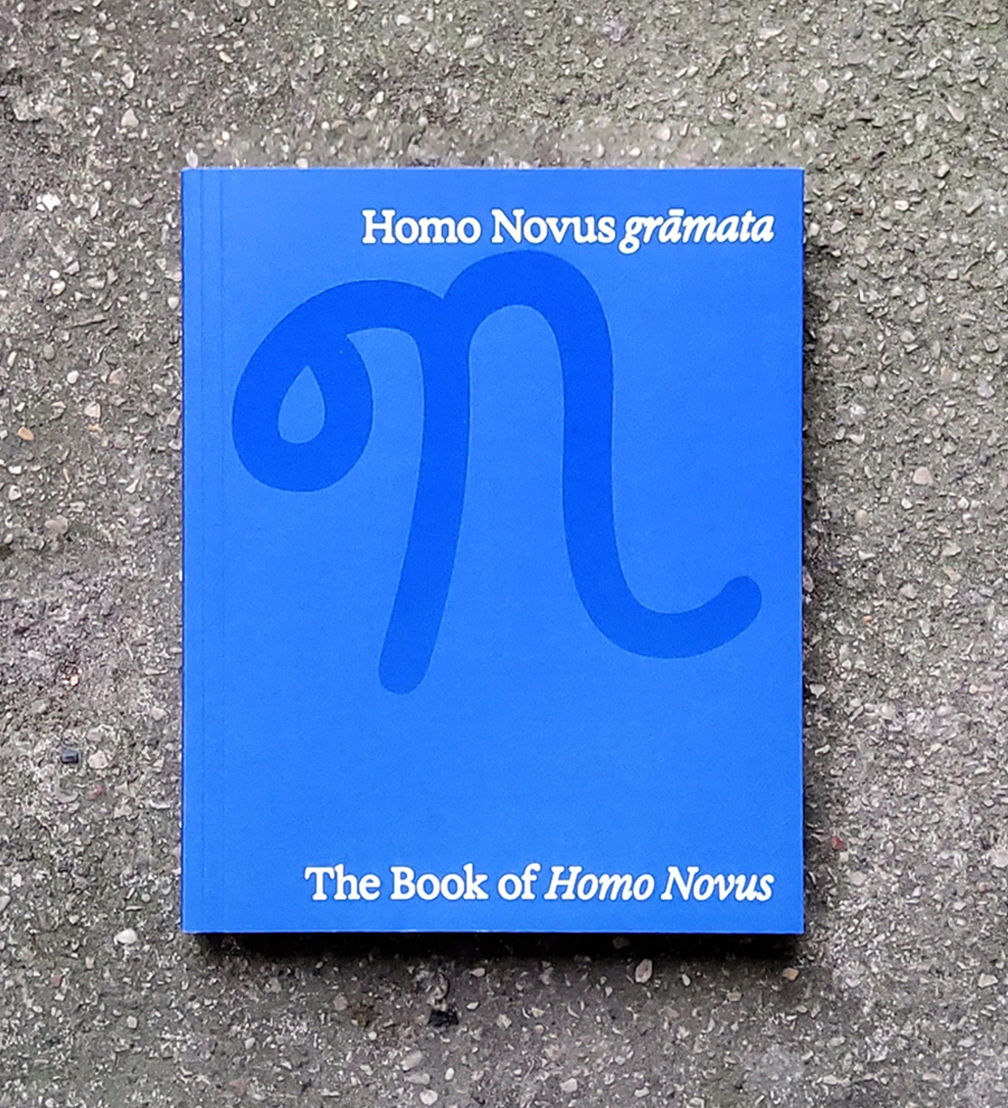
March 27 marked World Theatre Day, which highlighted the potential of theatre to address the changes the world is experiencing today. In Latvia, social and cultural processes are explored by the annual new theatre festival Homo Novus, which celebrated its 30th anniversary last year. To mark the occasion, the Book of Homo Novus was published, which not only summarises what has been achieved but also looks toward the future of theatre. The idea of movement and progression is also reflected in the publication’s design by Monika Gruzīte.
«In 2025, the international festival of new theatre Homo Novus took place for the 20th time and celebrated its 30th anniversary. Three decades and twenty festival programmes have created, accumulated, and refined a significant body of knowledge, experience, and practice, setting in motion undercurrents that shape and nourish our theatre landscape. There are many such currents — ranging from site-specific, documentary, and collaborative theatre to a focus on themes such as ecology, human rights, and accessibility. This book is a guide to active thinking and conversation about the theatre of tomorrow and the festival as an essential format for its development», writes the editor of the book, Gundega Laiviņa.
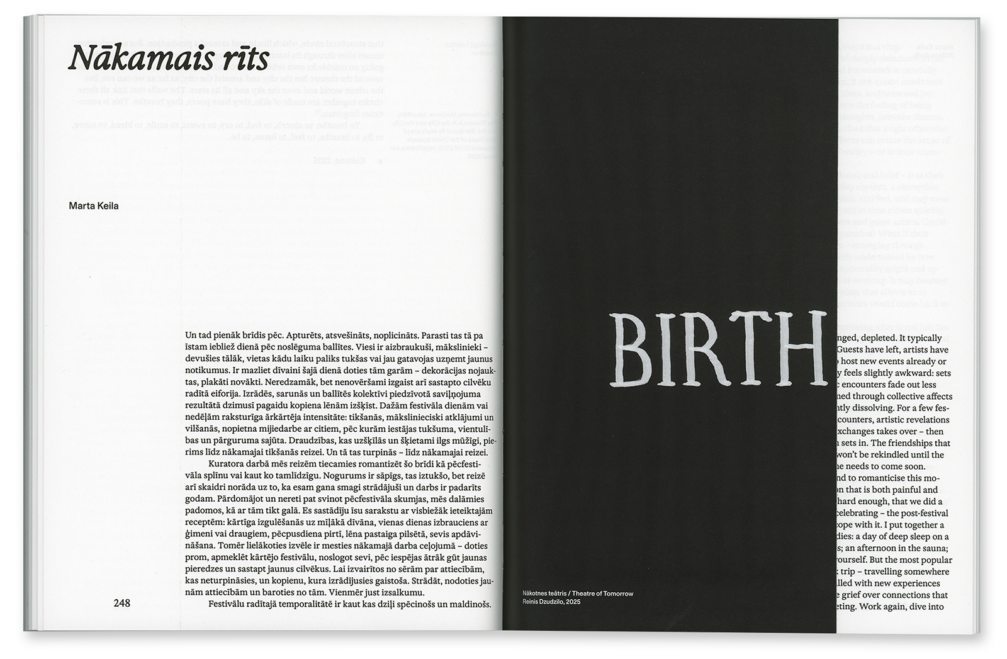
The designer of The Book of Homo Novus, Monika Gruzīte, notes that despite the publication’s considerable volume—344 pages—it is conceived as a «dynamic, light, and lively» book. «During discussions about the visual approach with the book’s co-authors Gundega Laiviņa, Santa Remere, and Raimonds Ķirķis, and as I delved into the texts, several concepts emerged that I was interested to embody in the design — creating a sense of movement, breaking down boundaries, forming new connections, and actively engaging the audience in the reading process.»
The bilingual publication brings together over 50 contributors — artists, creators and participants of the festival — who offer personal memories of Homo Novus and outline important theoretical themes. The authors also envision the future of theatre, bringing it to life through a series of images. These are printed on narrow-format sheets that partially overlap the text, simultaneously concealing and revealing the contents of the publication. «These pages are not used as illustrative material, but rather as an autonomous, parallel narrative thread that creates intuitive interactions and unexpected connections between the essays and images,» explains Monika.
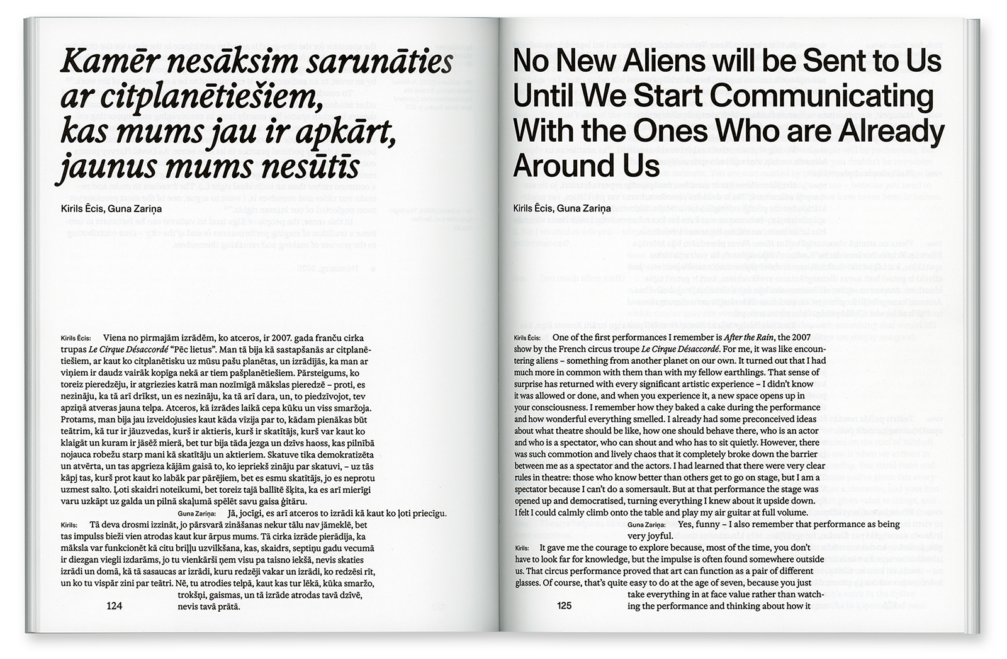
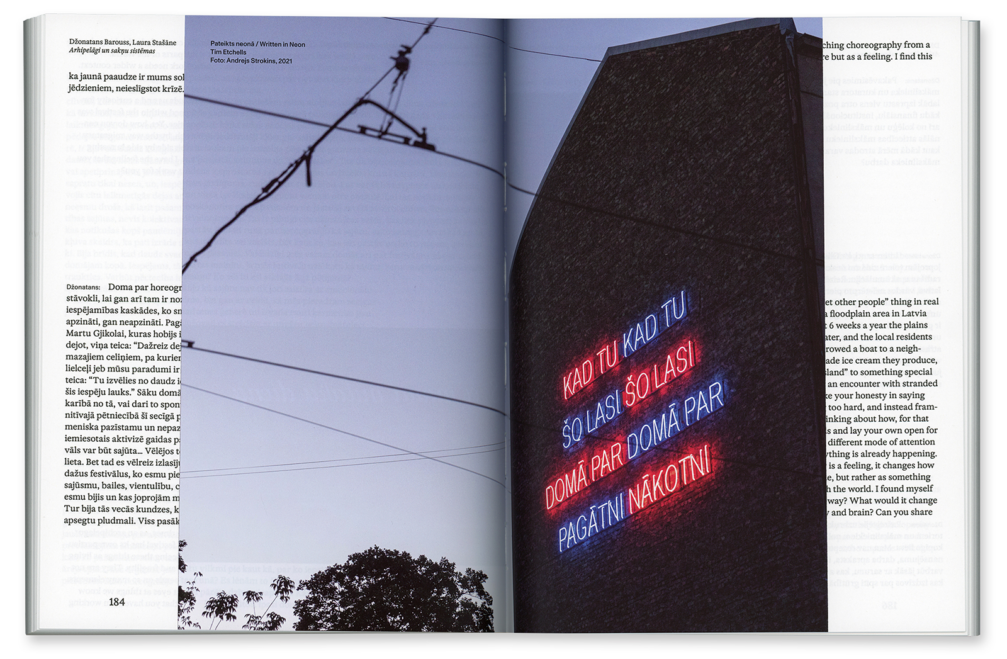
The sense of movement is also enhanced by the varied text layout — from dense, solid blocks of text to airy, experimental text compositions — which, in the designer’s words, «turns reading into an active process, encouraging the reader to explore the content from various perspectives and starting points». To foster interaction with the book, the designer has also focused on the publication’s tactile experience. Pages of text and images are printed on different papers, thereby highlighting the layering of the content. Meanwhile, the foil stamping and lamination coating used on the cover give the simple design a rich texture.
More information about The Book of Homo Novus is available on the festival’s website.



Viedokļi